
5 BOOKS THAT TAUGHT ME RESILIENCE — ONE STEP AT A TIME
A young man recently asked me if I could recommned any books…
I tried to think of something I’d just read. Or, at last something profound.
Nothing came to mind.
This was a chance to positively influence a young mind – a big motivator for me in recent years.
Suddenly it came - The Road Less Traveled.
This book kicked off a journey of personal growth and exploration that I'm still on 30 years later.
I can’t think of a better book recommendation, especially for a young traveler!
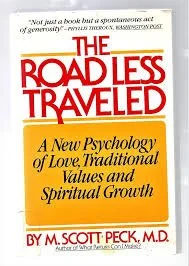
Written in the late 1970s, it introduced me to the idea that I am responsible for who I am – separate from my parents and the claustrophobic world I had grown up in.
In my house someone was either going to heaven…or not.
The book shaped how I saw the world and my place in it.
When I think about the books that have made a "deep impact on a deep level”, my list is fairly short.
In addition to Road, here are 4 more that played a profound role in shaping who I am and how I operate in the world today.
Keep reading below.
THE FIRESTARTER
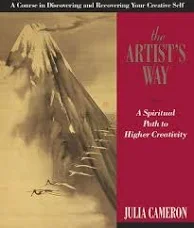
While reading The Artist's Way, I quit my job, sold everything, got a passport, and left the country for a year.
Except for a few extended visits, I've never been back.
I spent over 3 years in Far East Asia (S. Korea & Japan) and have lived in Germany since 2001.
This one lit a fire under my ass.
Leading up to my departure, I was into books by men who were all about uprooting their lives and sucking the marrow out of life.
I certainly wasn't the first person to join the moveable feast; however, it had moved continents.
I spent about 4 years teaching and traveling around Asia channeling my inner Henry Miller and Ernest Hemingway.
THE GAME-CHANGER
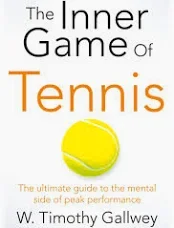
Coincidentally, I had just taken up the sport of tennis when I first read The Inner Game of Tennis.
When Tim Galloway explains the concept of relaxed concentration, I got it as both player and non-player - the idea that peak performance comes when concentrated but relaxed transcends the world of sports.
From returning a serve to public speaking, relaxed concentration applies to any endeavor where gripping something too tightly or trying too hard can adversely impact the outcome.
Nervousness might haunt you before making a speech, but you need to let it go once you begin talking – your audience will feel it if you don’t.
I once had the chance to stand up in front of a group and tell a few funny stories about my 2+ years in Japan – I thought they were funny.
The thing is – the stories I told are funny. That wasn’t the problem. There was nothing relaxed about my concentration, however.
The next time I have a chance to tell funny stories to a group of peers I’m going to channel this book.
THE REFRAME
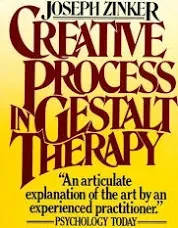
Before reading Creative Process in Gestalt Therapy I didn't recognize the role of creativity in my work.
It's not that I was opposed to it. I just didn't see it.
I wasn't a trained therapist like the author.
Not a painter or poet, either.
Nevertheless, I was essentially doing same thing he was.
Individual coaching involves two people and can get intense - especially when looking at a conflict or another emotionally charged area.
Funnily enough, I often explain my work “like a therapist in a business context”.
In a coaching session I once helped a coachee recreate a heated discussion with her boss.
So when Joseph Zinker writes about the creative exchange with a patient when applying the principles Gestalt, I recognize it immediately.
See my take on the “what makes people change”, taken from the 2018 Coaching Kongress in Munich:
Gestalt is all about trying things that raise one's awareness about something.
This often calls for experimentation.
In a therapy session you may recreate a conflict with your father or other difficult authority figure – whatever works to simulate a realistic experience.
In a coaching session, I’m not looking to revisit a different situation with a father; however, if I recognize a pattern of butting heads with an authority figure, I want to explore the performance-limiting pattern.
In the aforementioned non-therapy session, I aimed to shine a light on reoccurring conflicts with authority figures by recreating the tense exchange with the current boss.
Incidentally, there's no room for dogma in experimentation.
However, creativity is a must.
Above all, whatever the experiment looks like, you will be using real words, not hypothetical or ideal ones.
Can you feel the difference between 1 and 2?
1) “I would probably tell my boss that I was not happy with his feedback because…”
2) “You made me feel bad when you told me…”
There’s no power in number 1.
Number 2 allows you to revisit exchanges from yesterday or 30 years ago.
I’ve experienced this as both coach and coachee.
THE GUIDE
Gestalt theory embraces the Humanist principle that people have potential for greatness.
Growing up in a small Christian world, this blew my sinful mind.
Come to find out - people are neither good nor bad. They simply are.
I believe the ultimate life goal is to live in the present moment, as you are. No more. No less.
Despite roots in Psychoanalysis, Gestalt covers human interaction far beyond therapy
Before reading Humble Consulting, I heard Ed Schein interviewed at a 3-day conference.
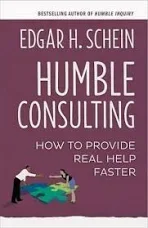
Although he never mentioned Gestalt, I had never experienced someone who better embodied its principles.
When working with people, for example, he recommends respecting their experience and what they bring to the table.
In other words, don’t try and be an expert on how they are and what they need. Ask them.
Respect in action.
Furthermore, never assume you know the answer to someone's problem or hold the secret knowledge they cannot access.
They know best. Not you.
Humble consulting, indeed.
Also, Gestalt in a nutshell.
Somehow, I had never come across this intellectual giant or his seminal work in Organization Development (OD).
A few years later I did a deep dive by serving on the board of ODNE - European OD Network.
My preferred learning method in action – “by doing”.
Since reading this book and other Schein classics, I’ve tried to integrate his approach with the principles that guide me in work and life.
NEVER-ENDING STORY
The Road Less Traveled helped me take responsibility for who I am and where I’m going.
The Artist's Way pushed me out of my cultural comfort zone.
The Inner Game of Tennis provided clear insights into what does (and does not) facilitate peak performance.
Creative Process in Gestalt Therapy helped me bring creative experimentation into my work.
Humble Consulting synthesized my learnings and experiences, specifically how I want to operate in the world.
By no means a straight line.
Resilience the through line in all.
Lessons still unfolding, decades later.
One step at a time.
What lesson are you still learning, years later?
I'd love to hear your story.