
RESILIENCE ISN’T A SKILL — IT’S A STORY
How can I bring out the true essence of this coachee - he’s clearly misplaced in his role as CFO?
What industry would be more aligned with who he is?

Based on this LinkedIn Recommendation, my decision to address the above questions via storytelling worked.
Stories tell me everything I need to know.
If you wish to really understand yourself, look no further than a personal story.
[Continue reading below the form]
A supervisor once told me that I was an outlier who actively seeks roles on the outside of things.
When I asked her to explain what she meant, she simply connected the dots of a few stories I had shared with her - living outside my country, marrying outside my culture, etc.
She was right; I was unaware, however.
I'm also convinced that the better you understand the stories that define you, the better you understand what makes you resilient.
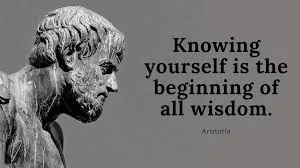
THIS GUY WAS ONTO SOMETHING
Think about it - if you've managed to navigate your personal and professional challenges this far, you are resilient - it's not just Elton John who is "Still Standing"!
When someone tells me a story, I quickly learn what they value and what's important to them.
If they tell me about an award they received, I know they value recognition.
If they mention a team accomplishment, I assume teamwork is a priority.
I'm currently working with a senior manager who told me about successfully running a big event a few years back.
Asking for personal stories has become a trusted technique that helps me understand the person I’m coaching.
Building relationships, problem solving and managing complexity all came through from the story. Loud and clear.
Stories do much more than highlight skills - they highlight values and principles, as well.
Understanding the values and motivators that drive you is key to understanding yourself.
If someone tells me about a conflict they want to resolve, especially if they recognize their part in it, it speaks to one or more of these 3 things:
+Solution-orientation - by focusing on solution, not problem.
+Responsibility mindset - by addressing conflict, not pushing it away.
+Courage - by facing the reality of how things are, not how they should be.
In addition to facilitating conflict resolution, all 3 facilitate problem solving.
Nothing builds resilience like solving a problem.
Stories also have the power to move you forward when you’re stuck.
I once had a therapist who would share a personal story, if she thought it would help me.
Not only did her story usually help me, I've repeated her stories countless times.
Most importantly, she wasn't attached to how her story affected me.
In other words, she didn't care if I "took it or left it". (More on that later)
Stories also help us relate to others - they make us feel human, with emotions, desires and intentions, not always pure.
Have you ever found yourself empathizing with a character in a story who was doing bad things?
I have. I loved Tony Soprano, Don Draper and a handful of other incredibly flawed antiheroes.
Without a doubt, personal stories, successful and unsuccessful, build resilience.
Think about it - Success stories help you repeat your wins.
When suffering from self-doubt or insecurity, they remind you of your superpowers.
I'm sure the biggest help Robin gave Batman was reminding him what he was capable of.

“I SAW IT WITH MY OWN EYES!”
The unsuccessful stories allow you to adapt and adjust.
Prior to kayaking around my favorite Greek island, I drew on my failures to make necessary adjustments for success.
Life would be pretty boring if you succeeded the first time you did everything.
If you did fail at something, it would be hard to bounce back, i.e. be resilient.
It’s the learning process that builds resilience.
With the aim of getting to know yourself better, here are 3 questions to ask yourself about a past or current conflict:
1) What did I learn about myself and others, i.e. relationship dynamics, from the conflict?
2) How could this learning help someone currently in a conflict move forward?
3) How can I share a story without being attached to the outcome?
Trust me, the “take it or leave it” approach of no. 3 is not easy.
As a coach but also as a friend, sibling, son, and partner, I've been badly disappointed when people haven't acted on the lessons of my story.
The truth is - my lessons might look differently from their lessons.
If you can't say "take it or leave it", you should not tell the story.
Of course, it’s frustrating and even painful when you are attached to an outcome that doesn't play out like you want.
Early on in my coaching career this was a huge challenge.
Why did he do this when I clearly told him not to...did my story mean nothing!
How could she have misunderstood the meaning of my story...was she not listening!?
Going beyond this self-coaching exercise, here’s the first and most important step to “disarm a conflict":
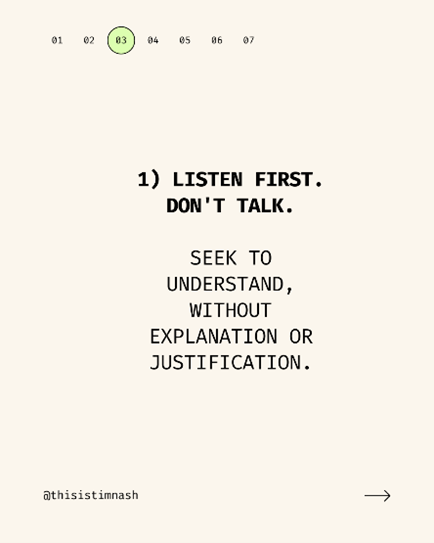
For the other 2 steps, check out this Instagram post.
In my experience, silence keeps conflict alive.
Talking moves away from it (see post).
There was a time in my career when I avoided conflict for the sake of harmony.
I was wrong.
What conflict are you avoiding for the sake of harmony?